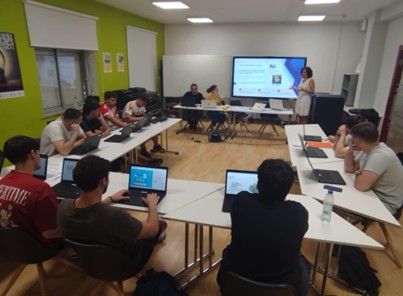
The second LET’s MIMIC multiplier event in Spain was successfully organised on 11 June 2026 at CIFP Juan de Herrera, a vocational education and training centre located in Valladolid, Spain (https://cifpjuandeherrera.centros.educa.jcyl.es).
The centre specialises in vocational training in mechanical manufacturing and vehicle transport and maintenance. These areas are particularly relevant to biomimicry, offering opportunities to apply nature-inspired design principles to challenges related to mechanical efficiency, sustainable manufacturing, material optimisation, energy consumption, and technological innovation.
The event brought together 16 participants, including VET students and teachers interested in exploring biomimicry as an innovative approach to sustainability-oriented vocational education and training.
The multiplier event introduced participants to the LET’s MIMIC project, its educational methodology, and its digital learning resources, while demonstrating how biomimicry principles apply to practical technical challenges in vocational training and professional environments.
The event emphasised connecting biological inspiration with engineering and technical competencies, encouraging participants to consider how natural organisms, structures, and processes can inform more efficient, functional, and environmentally responsible design solutions.
The event also provided an opportunity to explore how integrating biomimicry into vocational education can support green skills development, interdisciplinary learning, and the modernisation of technical training, helping prepare future professionals for increasingly sustainability-oriented industries.
The multiplier event featured an interactive presentation and practical workshop, combining an introduction to LET’s MIMIC, exploration of biomimicry principles, demonstration of the project’s digital learning platform, and collaborative application of nature-inspired problem-solving methodologies.
The session began with a presentation of the LET’s MIMIC project, its objectives, activities, and main educational outcomes. Participants learned about the project’s approach to promoting sustainability and green skills through biomimicry-based learning and innovative digital educational resources.
The presentation highlighted how biomimicry can enrich technical and vocational education by encouraging learners to explore biological strategies and consider their application to engineering, manufacturing, vehicle maintenance, and sustainable technological design.
Participants were subsequently introduced to the fundamental principles of biomimicry, exploring how organisms and natural systems have developed effective strategies for structural efficiency, movement, adaptation, resource optimisation, and environmental resilience.
Through illustrative examples and guided discussion, participants considered how natural structures and biological processes can inspire innovative approaches to technical challenges. The session placed particular emphasis on the relevance of nature-inspired design to mechanical performance, sustainable production, material efficiency, and environmentally responsible engineering practices.
The session also included a hands-on demonstration of the LET’s MIMIC Digital Learning Platform and educational resources. Participants were familiarised with the platform’s features and the opportunities it offers to explore biomimicry concepts, follow structured learning activities, and support collaborative problem-solving.